
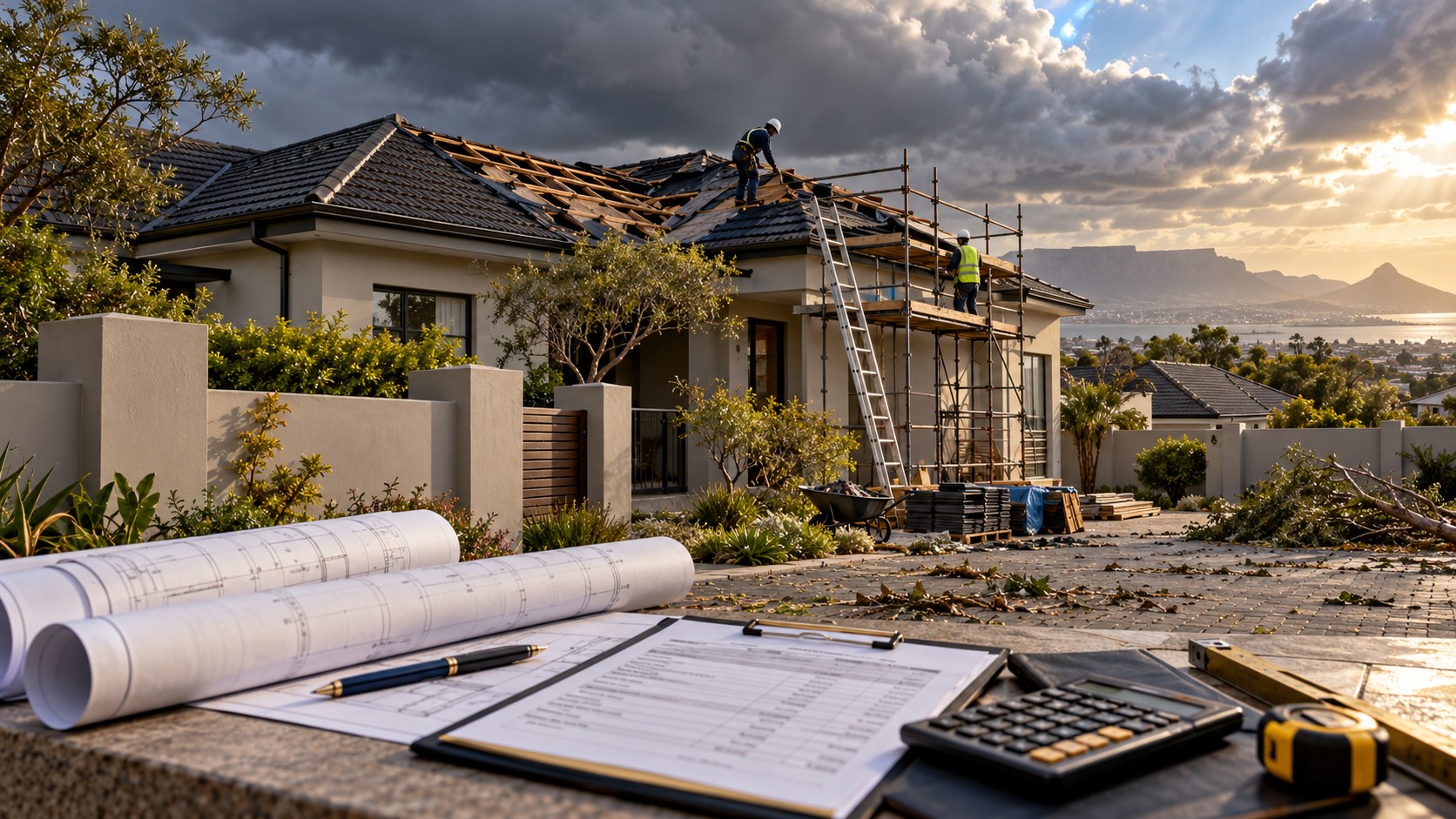
Imagine your home is insured for R3 million. That sounds reasonable because it is roughly what you paid for the property.
Then a severe storm causes R400,000 worth of damage.
During the claim, the actual cost of rebuilding the home is assessed at R4 million.
Your problem is no longer simply the storm damage. Your home may have been insured for only 75% of the value it should have carried.
That is underinsurance — and it can affect much more than a total-loss fire.
With Mpumalanga already moving into its summer thunderstorm season, including exposure to heavy rain, hail, strong winds and lightning, it is a sensible time for homeowners to check whether their building sum insured still reflects reality. The research supporting this week’s Radio Laeveld discussion identified this as a particularly relevant current household risk.
Market value and rebuild value are not the same thing
One of the most common mistakes is asking:
“What is my house worth?”
For building insurance, the better question is:
“What would it cost to rebuild this house today?”
Market value and rebuild value measure different things.
Your property’s market value is influenced by location, the size and value of the land, demand in the area, views, neighbourhood characteristics and what buyers are prepared to pay.
Rebuilding works differently.
If a fire destroys your house, the land has not disappeared. You already own it. The financial problem is the cost of reconstructing the building and restoring the insured structures.
This means a home with a market value of R3 million could cost more than R3 million to rebuild. It could also cost less. There is no reliable one-to-one relationship between the two.
A municipal valuation, mortgage balance or historic purchase price should therefore not automatically be treated as the correct building sum insured.
Why rebuilding can cost more than expected
Homeowners often think mainly about bricks, cement, roofing and labour.
Those are only part of the possible cost following a major loss.
Depending on the circumstances and policy wording, rebuilding may involve:
- demolition of damaged structures;
- removal of rubble and debris;
- making the site safe;
- architects, engineers or quantity surveyors;
- municipal or approval-related costs;
- reinstating garages, outbuildings and permanent improvements;
- replacing specialised finishes or materials; and
- dealing with difficult access or other site constraints.
A major reconstruction is also not necessarily comparable with building a new house on a clean, open stand. Before rebuilding starts, the damaged property may first need to be stabilised, assessed, demolished or cleared.
That distinction matters when homeowners rely on a simple construction cost per square metre and assume it represents the complete reinstatement cost.
The precise costs covered, and any limits applying to them, depend on the individual insurance policy.
Construction costs do not necessarily move with ordinary inflation
Another risk is assuming that an annual inflation adjustment automatically keeps the building adequately insured.
Statistics South Africa’s August 2026 construction input figures showed the total construction input index 8.3% higher than a year earlier.
South Africa’s headline consumer inflation rate for September 2026 was 4.5%.
That does not mean every home’s rebuild cost increased by 8.3%, nor should homeowners simply increase their building sum insured by that percentage.
It does demonstrate something important: construction costs and general consumer inflation do not necessarily move at the same rate.
An automatic annual escalation can therefore be useful, but it should not replace periodically checking whether the underlying rebuild value was correct in the first place.
Why underinsurance can affect a partial claim
Many people associate underinsurance with the complete destruction of a home.
That is only part of the risk.
Where a policy contains an average clause and that clause applies to a particular claim, underinsurance may also affect a partial loss.
Consider this simplified example:
Actual rebuild value: R4 million
Building sum insured: R3 million
The property is insured for approximately 75% of the required value.
Now assume a covered storm causes R400,000 damage.
If average applies, a simplified proportional calculation would be:
R400,000 × 75% = approximately R300,000
The homeowner could therefore face a shortfall of approximately R100,000, before considering any applicable excess.
The exact calculation and treatment will depend on the policy wording and circumstances of the claim. Average should never be presented as applying identically to every insurance policy.
The important point is simpler:
You do not need to lose your entire house before underinsurance becomes financially painful.
How does a home become underinsured?
It often happens gradually.
A house may originally have been reasonably insured, but the property changes while the insurance schedule does not.
Common examples include:
- adding another bedroom;
- building a garage or flat;
- adding a lapa or other permanent structure;
- upgrading finishes substantially;
- adding permanent improvements;
- failing to account for outbuildings, walls, gates or pools where relevant to the policy;
- relying indefinitely on automatic annual increases; or
- simply never reviewing how the original sum insured was calculated.
A useful warning sign is being unable to answer this question:
Why is my house insured for this particular amount?
If the answer is simply “because that is what it has always been”, the value deserves another look.
What should homeowners do?
Start with your current insurance schedule.
Find the amount for which the building is insured and ask what that figure represents.
Then check:
Is it based on rebuild value?
Do not assume a purchase price, municipal valuation or mortgage balance is suitable.
Have you changed the property?
Review extensions, outbuildings and permanent improvements made since the value was last assessed.
What does your policy define as the building?
Permanent structures and installations may be treated differently between policies.
When was the value last properly reviewed?
An annual inflation increase is not the same as re-establishing the correct underlying value.
Does your insurer provide a rebuild-cost tool?
This may provide a useful starting point, depending on the property.
Is the property unusual or complex?
Large homes, specialist construction, extensive outbuildings, thatch, luxury finishes or heavily modified properties may justify a professional rebuild valuation.
The objective is not to produce the highest possible number. It is to establish a defensible and realistic reinstatement value.
What about sectional-title properties?
Sectional title requires separate consideration.
South Africa’s Sectional Titles Schemes Management regulations place specific insurance responsibilities on the body corporate, including obtaining a replacement valuation of the buildings and improvements at least every three years and presenting it to the annual general meeting.
That statutory position should not be confused with the situation of an ordinary freestanding homeowner.
For a normal private home, the appropriate insured value is principally a matter of the insurance contract and, where applicable, requirements associated with a mortgage or finance agreement.
The financial consequence is bigger than the repair bill
Underinsurance is primarily a property issue, but its effects quickly reach the household itself.
A family may have to find a substantial amount of money unexpectedly, take on debt, delay repairs or reduce the standard of reinstatement.
If serious damage makes the house temporarily uninhabitable, the family may already be dealing with displacement, disruption and additional living costs.
A mortgage may still need to be paid while the property is being repaired.
The purpose of having the right building value is therefore not simply to satisfy an insurance requirement.
It is part of protecting the household’s ability to recover financially after a serious loss.
When should you get professional help?
A basic insurer calculator may be adequate as a starting point for many conventional homes.
Professional assistance becomes more important where the property is:
- large or unusually designed;
- finished to a high or specialist standard;
- extensively altered;
- constructed using specialist methods;
- thatched;
- spread across numerous buildings; or
- based on an insured value that has not been professionally reviewed for many years.
The aim is to understand the real reinstatement exposure before a claim exposes the problem.
This issue is the topic for this week’s Black Sable™ RISK property-risk discussion on Radio Laeveld.
The key takeaway
Do not simply check how much your house is insured for.
Ask:
What is that amount based on?
If nobody can clearly explain why your current building sum insured represents a realistic rebuild value, it is worth reviewing it before the next fire, storm or other serious loss tests the number.
Black Sable™ RISK’s broader property-risk approach is to understand what is actually on the property, what can go wrong and where specialist assessment may be needed. For complex properties, establishing accurate property information is an important starting point before relying on insurance values.
Sources and references
- Statistics South Africa — Construction Material Price Indices, August 2026
Published 30 September 2026. Supports the reported 8.3% annual increase in the total construction input index. - Statistics South Africa — Consumer inflation rises for a second straight month
Published 21 October 2026. Supports September 2026 headline CPI of 4.5%. - Statistics South Africa — Residential Property Price Index, May 2026
Supports the distinction between movements in property selling prices and construction/reinstatement costs. - National Financial Ombud Scheme South Africa — Non-Life Insurance Tips
Supports the importance of appropriate replacement values and the potential proportional effect of underinsurance where average applies under the policy. - OUTsurance — Building replacement-value guidance
Supports the distinction between market value and rebuilding cost, including consideration of professional fees, demolition, debris removal and site-safety costs. - Discovery — Safeguard your safe place
Supports the distinction between property market value and the replacement value relevant to building insurance. - South African Government — Sectional Titles Schemes Management Regulations
Supports the sectional-title replacement-valuation requirement.